Moneylender Cooling-Off Period Begins on 15 September 2026
-
Celine L
Author
-
September 4, 2026
Last Updated
-
13 min
To Read

Key Takeaways
- The mandatory moneylender cooling-off period will take effect on 15 September 2026.
- It applies to unsecured loans taken from licensed moneylenders, except business loans.
- Eligible borrowers will have three business days to cancel, excluding Saturdays, Sundays and public holidays in Singapore.
- No interest will be charged when an eligible loan is cancelled within the cooling-off period.
- For a principal of S$5,000 or less, the lender may retain up to S$50 of the approval fee.
- For a principal above S$5,000, the lender may retain up to 3.5% of the principal.
- The amount retained cannot exceed the approval fee actually charged, and the total cancellation repayment cannot exceed the original principal.
- Borrowers should confirm their eligibility, deadline and repayment amount directly with the licensed moneylender.
Borrowers sometimes reconsider a loan after signing the agreement and receiving the funds. The original expense may no longer be necessary, another source of money may become available, or the repayment schedule may feel less manageable after a second review.
The Ministry of Law has announced a mandatory three-business-day moneylender cooling-off period for eligible loans. The new framework will take effect on 15 September 2026 and will give borrowers a limited opportunity to cancel certain loans at a reduced cost.
The regulation does not automatically reverse every loan. It applies only to qualifying loans, and borrowers must complete the cancellation requirements within the applicable period.
Understanding the difference between the original principal, the amount disbursed and the approval fee is particularly important. These figures determine how much an eligible borrower may need to return.
Table of Contents
What Will Change on 15 September 2026?
According to the Ministry of Law’s announcement on the mandatory cooling-off period, eligible borrowers will be able to cancel their loans during a three-business-day window without being charged interest.
The licensed moneylender may still retain a permitted portion of the approval fee to cover work undertaken when assessing and granting the loan.
The key differences are summarised below:
| Cancellation cost or condition | Before the new framework | From 15 September 2026 |
|---|---|---|
| Mandatory cancellation period | No mandatory three-business-day period | Three business days for eligible loans |
| Interest upon cancellation | Accrued interest may be payable | No interest for an eligible cancellation |
| Approval fee | The full approval fee may be retained | Only a permitted portion may be retained |
| Total cancellation repayment | Dependent on the existing cancellation arrangement | Cannot exceed the original principal |
The new rule gives borrowers additional time to reconsider their decision. It does not remove the importance of checking affordability and understanding the contract before accepting a loan.
Which Loans Receive the New Protection?
The moneylender cooling-off period applies to unsecured loans taken from licensed moneylenders, except business loans.
An unsecured loan does not require an asset such as a property or vehicle to be pledged as collateral. A personal loan may fall within this category, although eligibility still depends on the nature and classification of the particular facility.
A loan generally needs to meet the following conditions:
- It was granted by a licensed moneylender.
- It is an unsecured loan.
- It is not classified as a business loan.
- The borrower is acting within the applicable cooling-off period.
Business loans are expressly excluded. A borrower should not assume that a loan qualifies simply because they signed the agreement in their personal name.
If there is any uncertainty about the loan’s classification, ask the lender to confirm whether it falls within the cooling-off framework.
How Does the Three-Business-Day Period Work?
The cooling-off period lasts for three business days, not necessarily three calendar days or exactly 72 consecutive hours.
Saturdays, Sundays and public holidays in Singapore are excluded from the count. A cooling-off period that crosses a weekend or public holiday can therefore extend across more than three calendar days.
| Day encountered | Does it count as a business day? |
|---|---|
| Ordinary weekday | Generally yes |
| Saturday | No |
| Sunday | No |
| Public holiday in Singapore | No |
Borrowers should confirm the precise cancellation deadline directly with the licensed moneylender. This is especially important when the period crosses a weekend or public holiday.
Waiting until what appears to be the final day may leave insufficient time to obtain the cancellation calculation and arrange repayment.
Three Amounts Borrowers Should Not Confuse
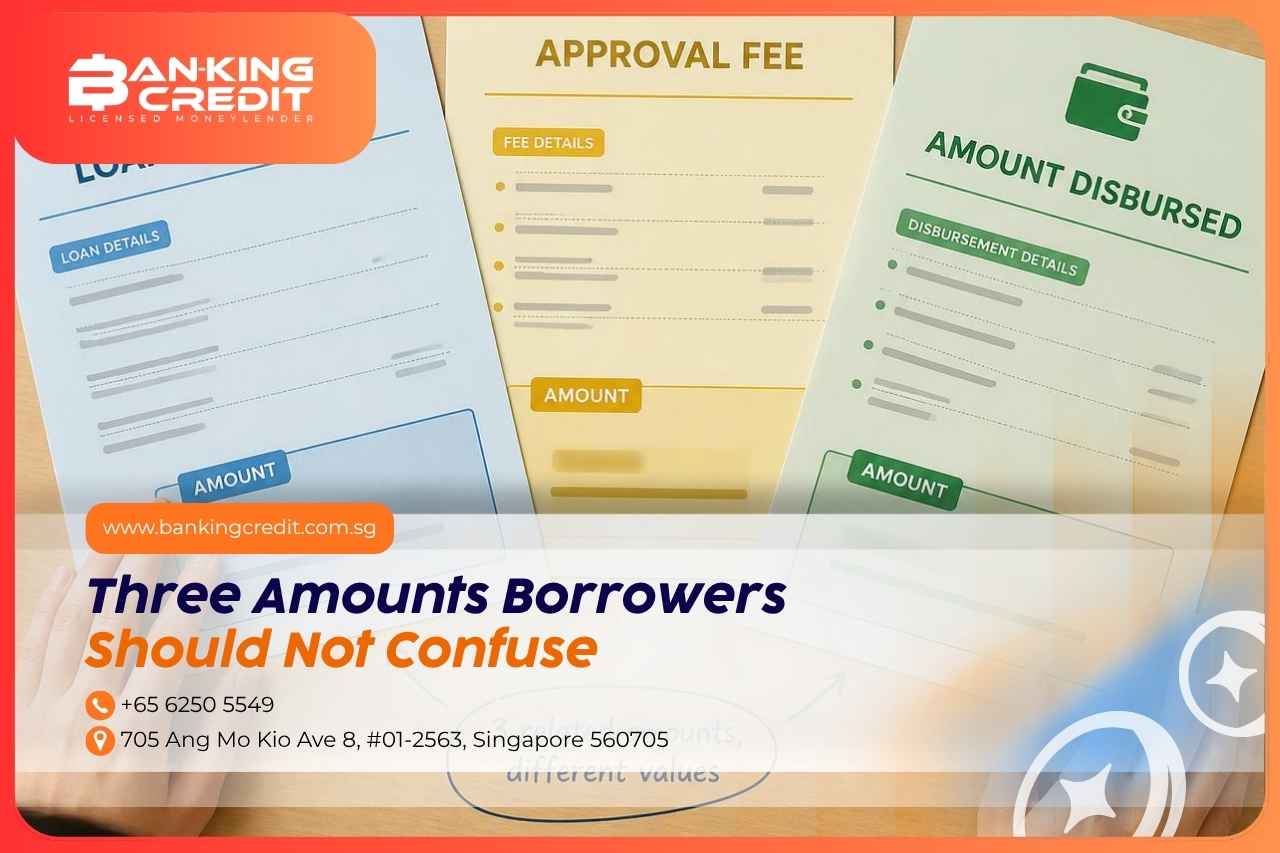
Before calculating a cancellation repayment, it helps to separate three different amounts.
1. Original Loan Principal
The principal is the original loan amount stated in the agreement before any approval fee is deducted.
For example, if the contract states that the borrower is taking a S$3,000 loan, the original principal is S$3,000.
2. Approval Fee
A licensed moneylender may deduct an approval fee when the loan is granted. The approval fee affects how much money the borrower actually receives.
Under the cooling-off framework, only a permitted portion of this fee may be retained when an eligible loan is cancelled.
3. Amount Disbursed
The amount disbursed is the money the borrower receives after the approval fee has been deducted upfront.
For example, if the principal is S$3,000 and an approval fee of S$300 is deducted, the amount disbursed is S$2,700.
These amounts are connected, but they are not interchangeable. The cancellation repayment is based on the amount disbursed and the permitted approval-fee retention, subject to the original principal as the overall limit.
How Much of the Approval Fee May Be Retained?
The portion of the approval fee that may be retained depends on the original principal.
| Original principal | Maximum permitted approval-fee retention |
|---|---|
| S$5,000 or less | Up to S$50 |
| More than S$5,000 | Up to 3.5% of the original principal |
These are maximum limits. The lender cannot retain more than the approval fee actually charged.
For example, if the original principal is S$4,000 but the approval fee charged was S$30, the lender cannot retain S$50. The amount retained would be capped at the actual S$30 fee.
For a principal above S$5,000, the percentage calculation is also subject to the same limitation. If 3.5% of the principal equals S$350 but the approval fee charged was S$200, the maximum retention would be S$200.
Why No Interest Does Not Mean No Repayment
An eligible cancellation will not attract interest, but the borrower must still return the loan money received.
The cancellation repayment generally consists of:
- The amount disbursed after the upfront approval-fee deduction; and
- The permitted portion of the approval fee.
The calculation can be expressed as:
Cancellation repayment = amount disbursed + permitted approval-fee retention
The final amount cannot exceed the original principal.
“No interest” therefore means that interest is not added to an eligible cancellation. It does not mean the borrower may retain the principal or that no payment is required.
How the Official Cancellation Examples Work
MinLaw provides two illustrations showing how the repayment amount is calculated.
Example 1: Principal of S$1,000
A borrower obtains a loan with a principal of S$1,000. A 10% approval fee of S$100 is deducted upfront, leaving S$900 to be disbursed.
If the borrower cancels within the cooling-off period:
- Original principal: S$1,000
- Approval fee charged: S$100
- Amount disbursed: S$900
- Maximum approval-fee retention: S$50
- Maximum cancellation repayment: S$950
The borrower returns the S$900 received plus up to S$50 of the approval fee.
Example 2: Principal of S$10,000
Another borrower obtains a loan with a principal of S$10,000. An approval fee of S$200 is deducted, leaving S$9,800 to be disbursed.
Three-and-a-half per cent of S$10,000 is S$350. However, the approval fee actually charged was only S$200. The permitted retention is therefore capped at S$200.
The maximum cancellation repayment is:
- S$9,800 disbursed to the borrower; plus
- Up to S$200 of the approval fee;
- Giving a maximum total of S$10,000.
This example demonstrates why borrowers must consider both the percentage limit and the approval fee actually charged.
What If Part of the Loan Has Already Been Spent?
Spending some of the loan does not reduce the amount required for cancellation.
Suppose a borrower takes a loan with a principal of S$3,000. An approval fee of S$300 is deducted, leaving S$2,700 to be disbursed.
If up to S$50 of the approval fee may be retained, the cancellation repayment could be up to S$2,750.
If the borrower has already spent S$600, only S$2,100 of the disbursed funds remains. The borrower would need to arrange up to another S$650 to complete the cancellation.
This is an illustration only. The actual amount depends on the borrower’s loan and the calculation provided by the licensed moneylender.
Borrowers who are still considering cancellation should avoid spending more of the funds until they have made their decision.
Compare the Cost of Keeping and Cancelling the Loan
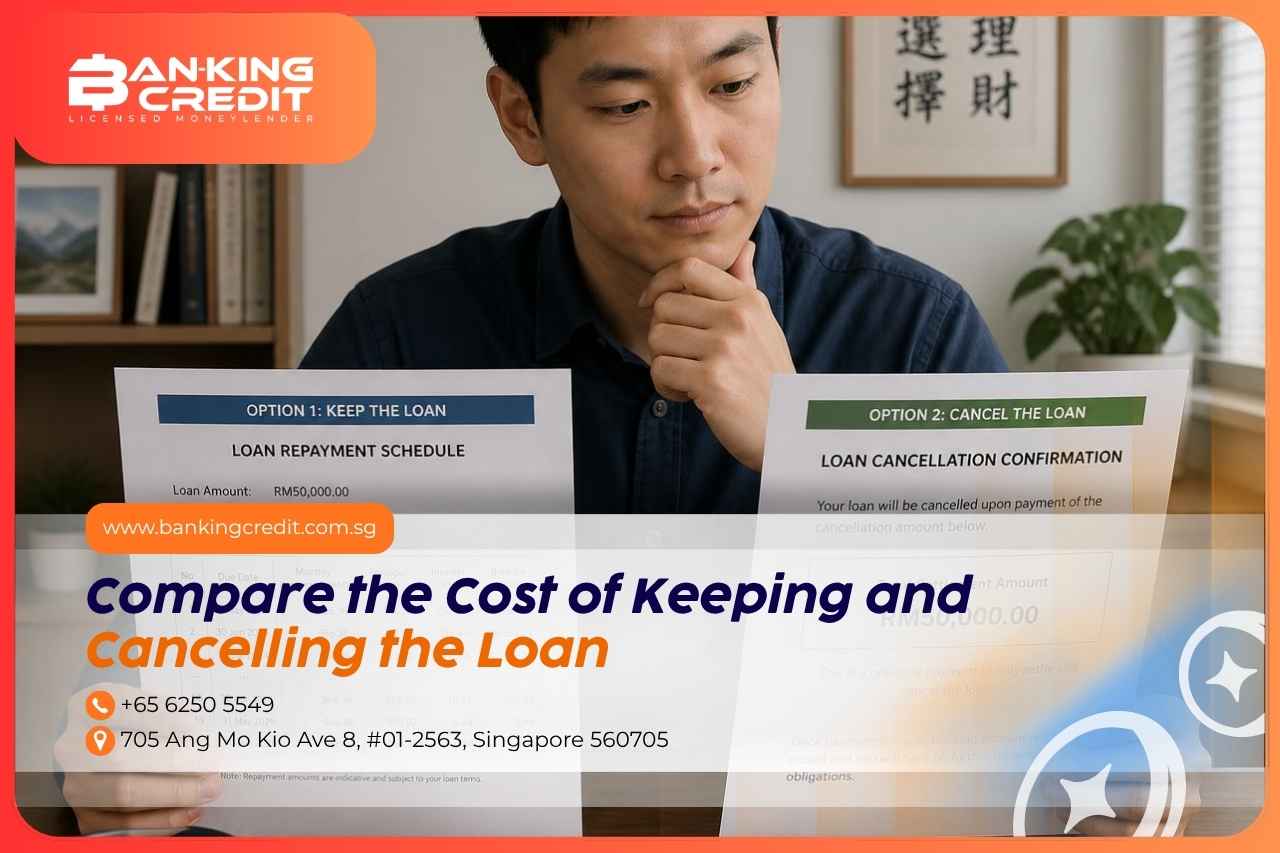
Cancellation may reduce borrowing costs, but it may not be the most suitable option in every situation. Borrowers should compare the practical effect of both choices.
| Consideration | If you keep the loan | If you cancel the loan |
|---|---|---|
| Use of funds | You retain the money for the intended expense. | You must return the required cancellation amount. |
| Interest | Interest applies according to the agreement. | No interest is charged for an eligible cancellation. |
| Approval fee | The fee is governed by the loan agreement and applicable rules. | Only the permitted portion may be retained. |
| Repayment obligations | The repayment schedule continues. | The loan ends after cancellation is properly completed. |
| Immediate cash flow | The disbursed funds remain available. | You need enough money to complete the cancellation. |
Before deciding, ask whether the original expense still exists, whether the scheduled instalments are manageable and whether another source of money would cost more.
Ban King Credit’s guide on how to borrow responsibly from a licensed moneylender provides further considerations for assessing repayment capacity.
Steps to Take If You Want to Cancel
Borrowers should act promptly if they decide to cancel an eligible loan. A practical approach is to:
- Contact the lender through an official channel. Use the contact details shown on its official website or loan documents.
- Identify the loan. Provide the agreement or account details needed for the lender to locate the transaction.
- Confirm eligibility. Ask whether the loan falls within the cooling-off framework.
- Check the deadline. Request confirmation of when the three-business-day period ends.
- Request an itemised calculation. Check the amount disbursed and the approval-fee portion being retained.
- Return the required amount. Use a payment method accepted by the lender and complete it within the applicable period.
- Obtain proof. Keep the receipt and ask for confirmation that the cancellation has been completed.
Always confirm that you are communicating with the correct business. Ban King Credit’s guide on how to choose and verify a licensed moneylender explains several checks borrowers can perform.
Records to Keep After Cancellation
Borrowers should retain a clear record of the transaction and cancellation.
Important documents include:
- The original loan agreement
- The itemised cancellation calculation
- Proof of the repayment transaction
- The official receipt issued by the lender
- Written confirmation that the cancellation is complete
- Relevant correspondence with the lender
Check that the amount shown on the receipt matches the amount paid. If there is an unexplained balance, contact the lender promptly and request clarification.
Informing the lender that you wish to cancel should not be treated as proof that the process has been completed. Retain confirmation showing that the required repayment was received and the loan was cancelled.
Frequently Asked Questions
When will the moneylender cooling-off period start?
The mandatory moneylender cooling-off period will take effect on 15 September 2026. Borrowers should not assume that the new three-business-day framework applies to a loan before that date.
Is the cooling-off period three days or three business days?
It is three business days. Saturdays, Sundays and public holidays in Singapore are excluded, so the period may extend across more than three calendar days.
Which licensed-moneylender loans qualify?
The cooling-off period applies to unsecured loans taken from licensed moneylenders, except business loans. Borrowers should confirm the classification of their loan with the lender if they are uncertain.
Are business loans covered?
No. Business loans are excluded from the mandatory cooling-off period, even though the lender granting the facility may be a licensed moneylender.
Is interest charged when an eligible loan is cancelled?
No interest will be charged when an eligible loan is cancelled during the cooling-off period. The licensed moneylender may still retain a permitted portion of the approval fee.
How much of the approval fee may be retained?
For a principal of S$5,000 or less, up to S$50 may be retained. For a principal above S$5,000, up to 3.5% of the principal may be retained. In either case, the amount cannot exceed the approval fee actually charged.
How is the cancellation repayment calculated?
The borrower generally returns the amount disbursed after the upfront approval-fee deduction, plus the permitted portion of the approval fee. No interest is added, and the total cannot exceed the original principal.
What happens if part of the loan has already been spent?
Spending part of the loan does not reduce the cancellation repayment. The borrower must still return the required amount within the applicable period to complete an eligible cancellation.
Reviewing the Real Cost Before You Decide
The new moneylender cooling-off period gives eligible borrowers a defined opportunity to reconsider an unsecured loan after it has been granted. However, cancellation is not automatic, and the borrower must still return the required amount before the deadline.
Separate the principal, approval fee and amount disbursed when reviewing the calculation. Confirm whether the loan qualifies, check the precise deadline and keep proper records after making the payment.
If you decide to retain the loan, review the repayment schedule and make sure each instalment can be managed alongside your essential expenses.
Borrowers who need clarification about Ban King Credit’s loan terms or the upcoming cooling-off framework may contact Ban King Credit for assistance. Any loan application remains subject to an individual assessment and applicable requirements.

Celine began her career in the financial sector as a client advisor, where she honed her communication and problem-solving skills for over four years. After taking a brief break to explore her passion for content creation, she transitioned into marketing, combining her understanding of finance with creative storytelling. Today, as a content marketing lead, Celine crafts campaigns that educate and inspire audiences to make informed financial choices. She believes that financial literacy should be empowering, and she’s committed to making complex topics simple and relatable through her work.

Let us guide you through our fastest, paperless Singpass application process.
Apply With
Related Articles

Moneylender Cooling-Off Period Begins on 15 September 2026
Key Takeaways The mandatory moneylender cooling-off period will take effect on 15 September 2026. It applies to unsecured loans taken from licensed moneylenders, except business...
- September 4, 2026
- 13 min read

Which BTO Areas in Singapore Tend to Be More Popular?
Key Takeaways: Popular BTO areas usually offer strong MRT connectivity, established amenities, and convenient access to workplaces or regional hubs. Mature estates such as Queenstown,...
- June 2, 2026
- 8 min read

Trending HDB Renovation Ideas in Singapore for 2026
Key Takeaways Smart home integration is becoming essential for HDB renovation ideas in Singapore, with homeowners adopting digital locks, automated lighting, and energy-efficient systems. Japandi-inspired...
- June 2, 2026
- 7 min read
 Apply With